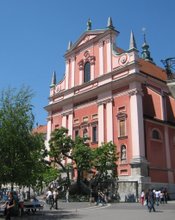
"Riot police using tear gas and batons dispersed hundreds of Serbian youths who ran riot through central Belgrade Sunday, targeting the embassies of Western backers of Kosovo's independence.
The youths, who numbered about 800 at the height of the violence, smashed the windows of two McDonald's restaurants, and those of the US and Slovenian embassies. Most of them appeared to be hardcore football fans.
The rioting lasted several hours and at least 50 people -- among them 20 policemen -- were injured during the rioting, radio B92 reported, quoting hospital officials."
Source: INQUIRER.net
Tuesday, February 19, 2008

Thursday, February 7, 2008
President of Slovenia visits the Pope, discusses country’s situation
'According to the Holy See’s Press Office, "The talks provided an opportunity to examine a number of matters concerning the current international scene, in particular the situation in the Balkans, also in the light of the Slovenian presidency of the European Union (January- July 2008).”
Mention was also made of the good relations that exist between Slovenia and the Holy See, as well as the need to ensure the protection of freedoms sought by the Church in Slovenia.
Pope Benedict considers the main challenge facing the Church in Slovenia to be "Western-style secularism”. Speaking to the Bishops of Slovenia earlier this year, he called this type of materialism “different and perhaps more underhand than Marxist secularism". It results in "the unbridled pursuit of material goods, the drop in nativity and the reduction in religious practice with a notable diminution in vocations to the priesthood and consecrated life".'
Source: CNA
EU mission to arrive in Kosovo at any rate, whatever happens
"Slovenia’s Minister of Foreign Affairs Dimitrij Rupel declared that the EU mission would be sent to Kosovo whatever happens over the next days, weeks or months, to guarantee the functioning of society, while the UN mission will withdraw from the region, Serbian Tanjung agency reported.
In an interview, Rupel remarked that UN secretary general Ban Ki-Moon has declared he backs the EU mission in Kosovo."
Source: FOCUS Information Agency
In an interview, Rupel remarked that UN secretary general Ban Ki-Moon has declared he backs the EU mission in Kosovo."
Source: FOCUS Information Agency
Friday, February 1, 2008
Croatia warns Slovenia not to block its EU bid
"Croatian President Stipe Mesic warned Slovenia on Thursday not to block his country's European Union membership bid as such a move could seriously harm ties between the two neighbours.
'If Slovenia prevents our entry into the EU by persistently insisting on its attitudes, it will be a disaster for our future relations,' Mesic said.
Such a scenario would mean that any 'friendship between Slovenia and Croatia is over for good,' he added.
The Croatian leader is to have an informal meeting on Friday with his Slovenian counterpart Danilo Turk, for the first time since Turk was elected in November.
Asked by journalists what he expected from the talks, scheduled to be held in Slovenia, Mesic emphasised they would be informal to give them a greater chance of success.
Croatia accuses its northern neighbour of using its current six-month term in the EU presidency to press Zagreb over unsolved bilateral issues. Slovenia has rejected the charges."
Source: EUbusiness.com
Slovenia under US influence?
"Mitja Drobnic has withdrawn as director in the Slovenian Foreign Ministry after the minutes of a private discussion between himself and a top US diplomat were revealed. The document gave the impression that Slovenia, which holds the EU Council presidency, would take its cues from the USA regarding the Kosovo issue. Antisa Korljan comments: 'It's no surprise that a scapegoat was found in the ministry. To some extent, Drobnic was the logical choice, because his name alone comes up in close connection with the minutes of the meeting."
Source: Courrier international
Source: Courrier international
Wednesday, January 30, 2008
Slovenian diplomat quits after report of US meddling in EU presidency
"The Slovenian foreign ministry announced the resignation of a top Slovenian diplomat Tuesday who press reports claimed had taken orders from the United States about Slovenia's EU presidency.
The Foreign Ministry announced on its website that political director Mitja Drobnic had resigned and would be replaced by state secretary Matjaz Sinkovec during Slovenia's six-month term as EU president.
Foreign Minister Dimitrij Rupel 'has accepted the resignation of political director Mitja Drobnic', the ministry said in a statement.
The resignation comes after a report in the daily newspaper Dnevnik last week which said that Slovenia had been taking orders from the US.
According to the newspaper, which quoted an internal foreign ministry report, Drobnic had met in December with US Assistant Secretary of State Daniel Fried, who allegedly suggested to the Slovenian side what their priorities should be during the EU presidency.
Fried encouraged Slovenia to be among the first to recognise the independence of the breakaway Serbian province of Kosovo, the newspaper claimed."
EUbusiness.com
Slovenian Press Freedom
"The director of the International Press Institute, Johann Fritz, warned in an official statement that 'business contacts and stock ownership should not be used by the government to influence independent media into publishing positive articles.'
But Grah, the Vienna correspondent for Delo, said there are now only two papers -- Dnevnik and Mladina -- that are not subject to state influence. Those news outlets are suffering from a lack of advertising, however. Big companies have pulled their ads from the critical newspapers, costing them a significant portion of their revenues.
In order to answer the critics, the Ministry of Culture funded a study at the University of Ljubljana, on press freedom. The researchers found that the reporting in Slovenian papers was even-handed, but sociologist Matej Makarovic, who conducted the research, found that the government and other political parties had tried to influence it."
Source: Deutsche Welle
Subscribe to:
Posts (Atom)